

Data
Local AI: when your data should not leave the company
Not every AI workload has to run in the cloud. Where a process involves medical data, research results or commercial calculations, the AI layer, meaning our system that works on company data, can run on a device inside the company. The data stays on site, access to the system does not depend on an external provider and the costs are predictable.
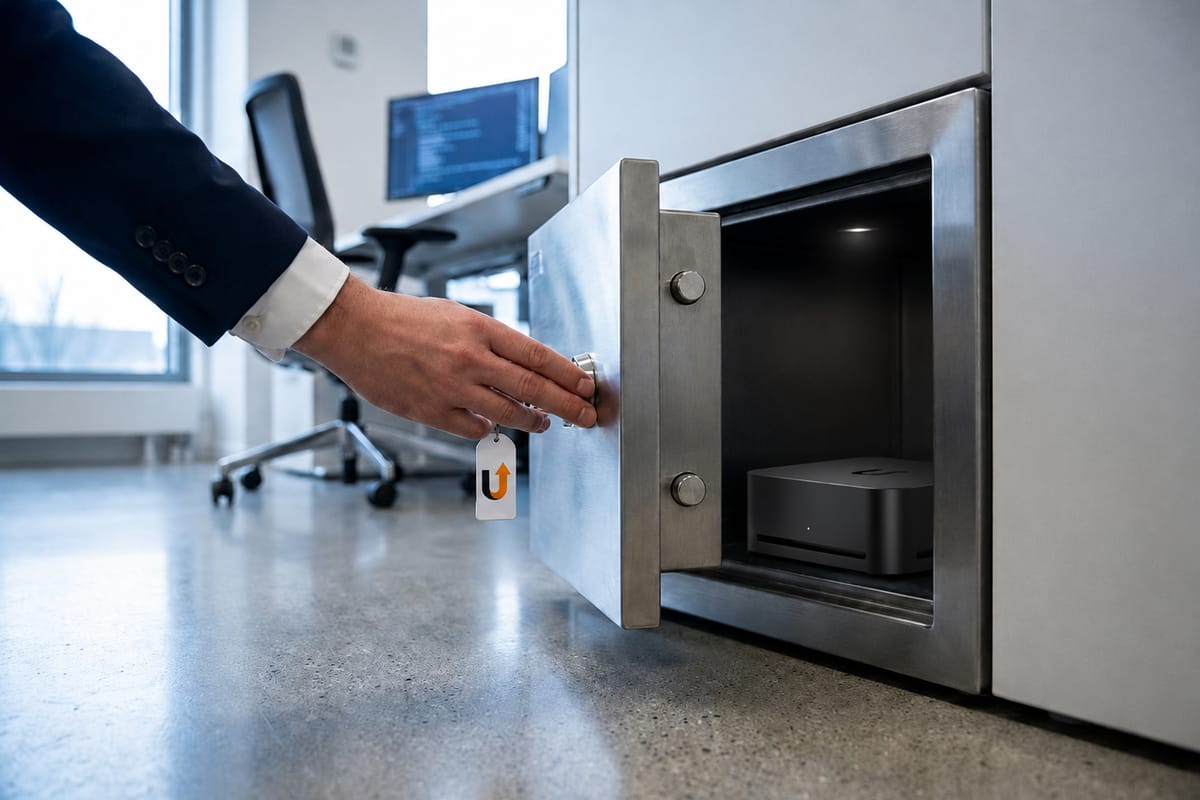
Which data stays in the company
Most companies have data that should remain on site: research and development results, pricing calculations, customer data or medical records. For this reason, a company may decide not to use AI in the processes where it would bring the greatest value.
Local AI keeps this data inside the company. The AI layer runs on a device at the company's site and processes data only within its network. The device does not maintain a permanent connection to an external network. This applies to both inbound and outbound traffic. Updates are made only during agreed service windows, initiated by the company and recorded in the register. Customer data is not used to train models. For each process, we record in the agreement whether and for how long the device stores the content of queries and documents. The device can be configured not to keep them permanently once a task is finished.
How the local device works
The team's way of working remains the same. The AI layer reads documents and mailboxes, prepares summaries and draft replies, and performs repeatable steps. It also handles images and video. Under this option, all the work takes place inside the company's network.
The device is the size of a small desktop computer and draws little power. Its disk is encrypted, and the hardware sits in the company's server room or rack, under its physical control. If we act as the operator, we take responsibility for operating the device, updating the models and checking that it runs correctly. We have no permanent remote access to the company's data. For every service window we agree the date and scope with the company, and the work performed goes into the register. Under this option, the company does not need to build its own team to operate AI infrastructure.
What changes in access and costs
In the cloud, the company faces two unknowns. The first concerns access, because it has no control over query limits, changes to model versions or outages at the provider. The second concerns the bill: the prices of models and APIs, through which systems exchange data, change, and the cost increases with the number of documents and queries.
The local device operates independently of provider limits and outages. Costs are predictable because they do not depend on changes to model and API pricing. This matters when there are many similar tasks.
One deployment option
The local device is available at the company's request. It is one deployment option for the layer, and we define the device's capabilities in advance. By default, the layer runs in an isolated environment: a dedicated place where a single company's data is processed, within the EU. If the data should remain inside the company or costs must be kept under control, the process can be moved to a device on site. We assess each process separately with the company.
The limitations of local AI
We explain the limitations before a decision is made. The most demanding tasks take longer locally than in a large cloud environment. Most day-to-day work, however, involves simpler or specialised tasks for which the local pace is sufficient. A single device handles an agreed scope of work, and handling more cases requires another device. Connecting data sources, granting permissions and preparing the team require work at the outset, as with any AI deployment.
The first step remains the same: one process, a measured baseline and read-only access to the data. Wondering which data in your company can be processed in the cloud and which should stay on site? Write to us through the contact form or at kontakt@uruchom.ai. Within one working day, we will send three questions about the process and propose a 45-minute call. We will prepare the first-stage outline after that call. It will show where local AI makes sense.
Back to all posts