
+14 NPS points, to 64
Vodafone
In Portugal, SuperTOBi raised first-time resolution when booking appointments from 15% to 60%. NPS, the customer loyalty index, rose by 14 points to 64.
Vodafone published 4 July 2024
We deploy AI in medium-sized companies and large enterprises
Many AI pilots end without a concrete, measurable result. We start from one process instead, such as invoice or order handling, and automate its most time-consuming part. If we do not achieve the agreed result, the company pays nothing for the next stage.
We calculate each stage's result from company data using a written ruleFirst stage: read-only.
Within one working day, we will send three questions about the process and propose a 45-minute call. We will prepare the first-stage outline after that call.
Medium-sized companies and large enterprises
We start with one process that covers many similar cases, and one number to improve. You know the price of the stage and its result before work starts. You also know what happens if the threshold is missed.
Terms and the outcome threshold·How to choose your first process
The terms are the same. Change control, security and procurement join the process. Before the decision is made you get the data location, the scope of access and the person who owns the result.
Where the data runs and what procurement receives·Data access for IT
Short route: what it is, terms and threshold, data access, contact.
How it works
The AI layer connects the data needed in production, warehousing, finance and document workflows. We put it into operation once, then add further processes stage by stage at an agreed pace.
The uruchom.ai layer brings together the data from ERP, email and documents needed for a particular case and operates in read-only mode from the outset. A person on the company's side makes decisions with real consequences.
People
a person on the company's side makes the decisions
The uruchom.ai layer
reads data from ERP, email and documents
Company systems
continue working as before, unchanged
Public market examples
These are public examples of AI in use. They are not uruchom.ai client results; each description links to a source published by the organisation or the solution provider. Names and trade marks belong to their respective owners.
Vodafone
In Portugal, SuperTOBi raised first-time resolution when booking appointments from 15% to 60%. NPS, the customer loyalty index, rose by 14 points to 64.
Vodafone published 4 July 2024
up to 7 hours
saved on a single contract analysis
30% less contract review timeA&O Shearman / Harvey
Around 2,000 lawyers use ContractMatrix every day. Harvey reports a 30% reduction in contract review time and savings of up to 7 hours on a single analysis.
Harvey / A&O Shearman accessed 10 July 2026
over 1.5 million
documents processed per quarter
Bank Pekao
The przeczytAI system reads and classifies banking documents, then extracts data from them. The bank reports processing more than 1.5 million documents per quarter.
Bank Pekao published 30 April 2025
over EUR 200 million
saved through AI initiatives in 2024
nearly 15,000 employees in 2 monthsSantander
Santander reports that its AI initiatives delivered more than EUR 200 million in savings in 2024. The bank also made ChatGPT Enterprise available to nearly 15,000 employees within two months.
Santander accessed 3 August 2026
around 12,000
claims verified each year after the first deployment phase
in undisputed cases: payout the day after filingPZU
Samoobsługa NEXT, PZU's self-service channel, uses generative AI (GenAI) for straightforward, relatively low-value claims in selected PZU Dom insurance categories. After the first deployment phase, PZU expects to verify around 12,000 claims a year. In undisputed cases, the customer receives the payout as soon as the day after filing.
PZU published 3 February 2025
We describe the whole engagement model, stage by stage, in What working with uruchom.ai looks like.
Data access
Before discussing a deployment, the IT department will usually ask what the system will do with the company's data. The access rules are set out below, point by point. This page can be sent to the IT department before the first conversation with us.
The source data, decision register and process design, meaning the written way in which a case is handled, stay with the company.
01
The layer reads data and changes nothing. No business record is added and no field is changed. The source system records our reads in its logs, meaning the technical records of access. The reads are also visible in session records. A database administrator can check both types of record. Write access is considered only after the first stage and once agreed with the company.
02
The layer gets technical access that allows it to retrieve data but not to change it. This can be an account with read permissions, a database view, a scheduled export or a mailbox that receives copies of documents. The company's IT department chooses the form.
03
We agree the read scope with the IT department field by field. At the first meeting, we usually ask for less data than the company expects to share. Every field must be needed for a specific task. If we cannot explain why a column is needed, we leave it out of scope.
04
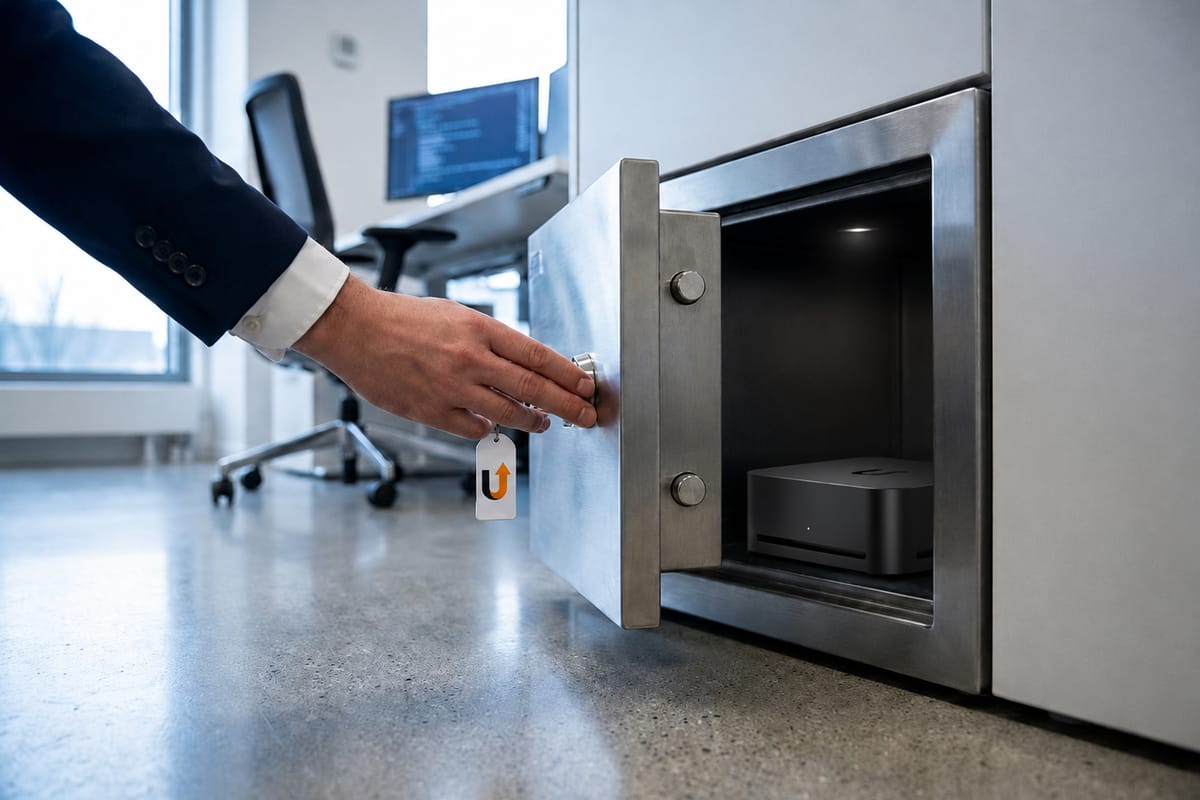
The retrieved data goes to an isolated environment: a dedicated place where one company's data is processed. Its location is agreed at the start. Where data is sensitive, the AI layer can run on a device in the company's network. We describe how that works below, under the third option.
On working from a device inside the company: Local AI, 16 July 2026.
For IT and procurement
These answers can be forwarded without us present. The company chooses the deployment option together with its IT department.
Default option
The environment serves one company and operates in an agreed location within the EU. Before work begins, we identify the location and the processors and record them in the agreement.
Second option
The layer runs in the company's cloud or data centre when its data policy requires this. The scope of access remains the same.
Third option
The local AI runs on a device within the company's network and processes data there. The device has no permanent connection to an external network, for either incoming or outgoing traffic. The company initiates updates only during agreed service windows, and every update is recorded in the register. More demanding tasks take longer. A higher volume of cases requires another device.
We do not use client data to train models under any option. We design the system that way and record it in the agreement.
Current information on data processing: Privacy notice. A summary of the architecture and access model for IT: technical note (PDF).
Team
A team on our side is responsible for each implementation. It agrees the scope with the IT department, makes sure measurement is in place and manages the work throughout the stage. During this time, the company has one point of contact. The uruchom.ai team builds and operates the AI layer, understands its impact on the profit and loss account and creates the necessary tools itself.

Dawid is a systems engineer. He has spent nine years developing software for high-reliability systems. His day-to-day work includes building and maintaining AI tools, including systems that perform a sequence of tasks according to an agreed plan.
LinkedIn profile
Alexandre has spent more than twelve years developing software for high-performance computing and leading research and development work. He focuses on connecting AI with company systems.
LinkedIn profileBlog
Contact
Tell us what your company does and which task takes your team the most time.
The controller of the data from this form is uruchom.ai sp. z o.o., ul. Jana Heweliusza 11/811, 80-890 Gdańsk (KRS 0001245954). We use the data solely to reply to your message and continue the conversation, on the basis of Article 6(1)(f) GDPR: our legitimate interest in handling enquiries addressed to the company.
Providing the data is voluntary, but both required fields are needed for us to reply: without an email address and the message itself, a reply is not possible. We delete correspondence 12 months after the last message. If the conversation leads to an engagement, we retain the data for the duration of the contract and for the period required by accounting and tax law.
You have the right to access, rectify and erase your data, to restrict its processing, and to lodge a complaint with the President of the Polish Data Protection Authority. The full notice, including the list of providers and transfers outside the EEA, is in the Privacy notice.
You can object to our processing of your data at any time. An email to kontakt@uruchom.ai is enough. We will then stop, unless we can demonstrate compelling legitimate grounds which override your interests and rights.
Within one working day, we will send three questions about the process and propose a 45-minute call. We will prepare the first-stage outline after that call.
You can also review our backgrounds on LinkedIn: Dawid Juc Alexandre Matwiszyn